How to Dial In an Espresso Grinder: The Three-Lever Loop
Most dial-in advice says 'grind finer until the shot slows down.' That's one lever pulled in isolation. Here's the full loop — grind, yield, time — in the order pros actually work it.
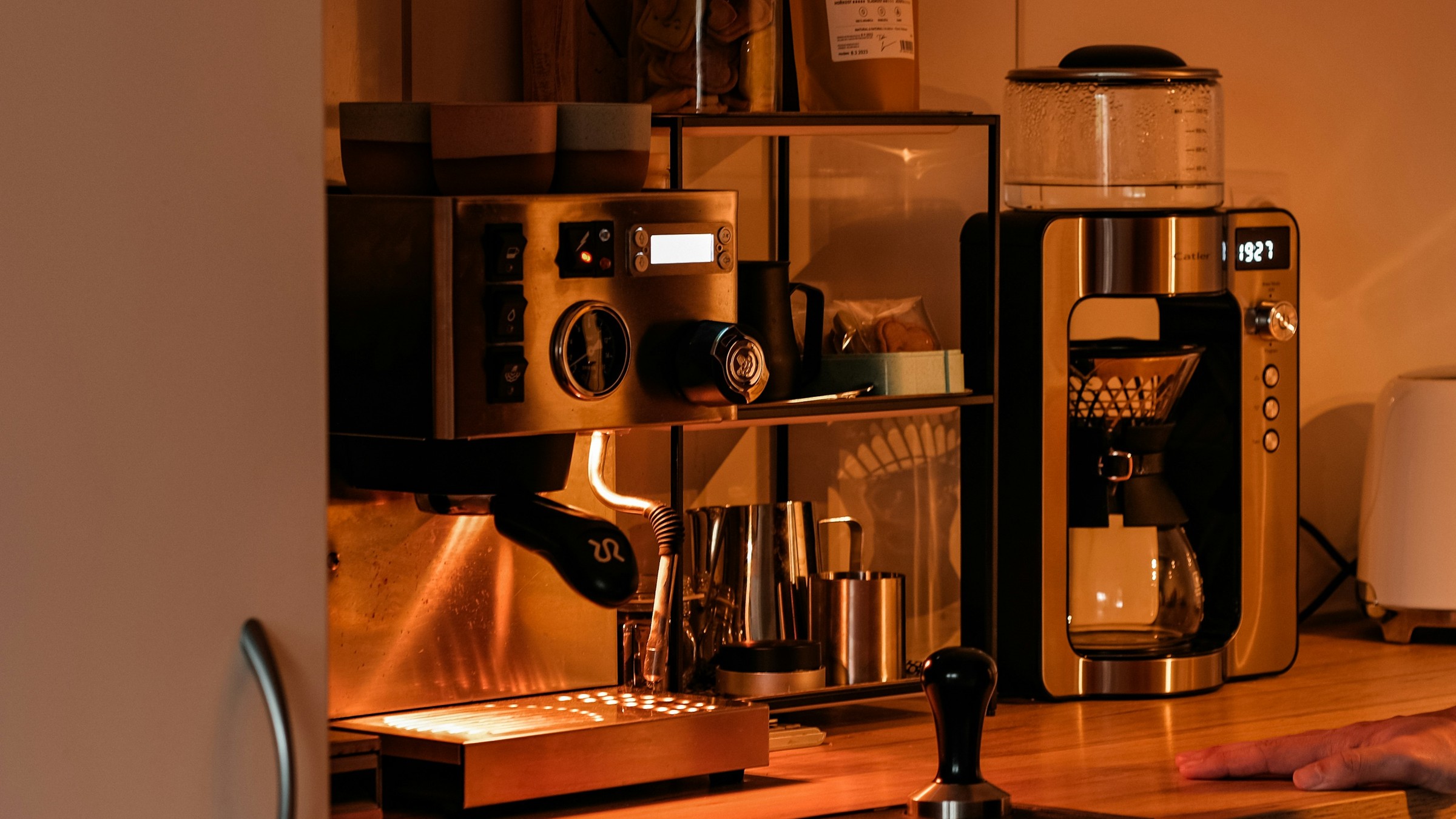
Most "how to dial in an espresso grinder" guides tell you the same thing: grind finer until the shot slows down. That's one lever, pulled in isolation, and it's why so many first bags of beans end up bitter, sour, or both on the way to tasting right.
Dialling in is not a single adjustment. It's a three-lever loop — grind, yield, and time — worked in a specific lock order. Get the order right and most shots are drinkable inside three pulls. Get it wrong and you'll burn through 80 grams of beans chasing a moving target.
This guide gives you the loop, a printable decision table for when a shot goes sideways, and per-grinder quick-starts for the four grinders we see most often in reader setups: the Eureka Mignon Specialita, Breville Smart Grinder Pro, Baratza Sette 270, and Niche Zero. If you just unboxed your first stepless grinder and you're staring at the dial wondering where to start — start here.
[Beginner-friendly section] If terms like yield, ratio, or extraction time don't mean anything yet, jump to the glossary at the bottom, then come back up. The rest of the guide assumes them.
The three-lever loop, in lock order
[DIAGRAM: three-lever loop — grind → yield → time] Rendered asset slot. Layout: three arrowed nodes in lock order — Grind (leftmost, bold/active), Yield (centre, locked), Time (rightmost, read-out). Palette per BrewGear Crema/Espresso guidelines.
The loop is three variables you can change on every shot:
- Grind size — how fine the coffee is ground.
- Yield — how much liquid espresso ends up in the cup (measured in grams).
- Time — how long the shot takes to pour, from pump-on to cut-off.
The trap beginners fall into — and the reason the dominant SERP advice under-performs — is treating these as three independent dials. They aren't. They're a chain. Change grind, and time moves. Change yield, and both the taste and the time move. Chasing all three at once is how dial-in turns into a 12-shot afternoon.
The fix is a lock order: fix two variables, move the third, read the outcome, then re-lock.
- Lock the yield first. Pick a ratio — usually 1:2 by weight (18 g in, 36 g out) — and do not change it until the rest of the shot is tasting right. This is the ground rule baristas work under too: Barista Hustle describes dialling in as "holding ratio constant while adjusting grind to hit a target time" (Barista Hustle).
- Move the grind. Grind is the lever that changes most between bags, roasts, and days. You move it, pull a shot at the locked yield, and measure what happens to the time.
- Read the time, then taste. Time is the symptom, not a lever you set directly. A 1:2 shot that takes 28 seconds is usually in the zone. One that runs 15 seconds is too coarse. One that runs 45 seconds is too fine. But time is only a proxy — taste is the final arbiter, which is where most beginner guides stop short.
Lock yield, move grind, read time and taste. That is the loop.
Lever 1: Grind — the one you actually move
For most home setups, grind is the only lever you adjust between shots. Everything else (dose, ratio, temperature, puck prep) should be held steady so you can isolate what the grinder is doing.
How much to move:
- Stepless grinders (Eureka Specialita, Niche Zero): a quarter-turn of the collar is a meaningful change. An eighth-turn is a nudge.
- Stepped grinders (Breville Smart Grinder Pro, Baratza Sette 270): one full step is often too big a jump between espresso settings. Use micro-adjustments if the grinder offers them.
A common mistake is moving in huge increments because the first shot was clearly off. If 18 g in produced a 20 g shot in 40 seconds, the impulse is to crank coarser by a full number. Don't. Move small, pull again, and let the grinder's resolution do the work.
Lever 2: Yield — lock it, then leave it
Yield is a weight, not a volume. You need a scale under the cup. A scale that fits under your group head and reads to 0.1 g is the single most useful piece of kit after the grinder itself — Perfect Daily Grind calls weighing the shot "the step that turns guesswork into consistency" (Perfect Daily Grind).
Pick a ratio and stay there for the whole dial-in:
| Shot style | Ratio | 18 g dose → yield |
|---|---|---|
| Ristretto | 1:1.5 | 27 g |
| Normale / "standard" | 1:2 | 36 g |
| Lungo | 1:3 | 54 g |
For your first dial-in on any new bag, default to 1:2. It's the widest tasting window and the easiest to read. Move to ristretto or lungo only once 1:2 is landing where you want it.
Lock your target and stop the shot when the scale hits it — not when the stream turns blonde, not when the timer hits a round number. The scale is the judge.
Lever 3: Time — the signal, not the setting
Time is the number people obsess over because it's the one the machine shows you. It's also the one you don't set directly. You set grind and yield; time is what falls out.
A useful target band for a 1:2 espresso shot is 25–32 seconds from the moment you press the brew button to the moment the scale hits yield. Inside that band, you're in the zone for most modern roasts. Outside it, something needs to move.
The practical test at the end, though, is your mouth. A 28-second shot can still taste sour (under-extracted for that coffee) or bitter (over-extracted). Taste trumps time. Time is just the fastest way to know whether grind is in the right postcode before you commit to tasting.
The actual dial-in loop, shot by shot
Here's the loop in practice, for a fresh bag of beans you've never ground before:
- Set the dose. 18 g for a standard double basket. Weigh it in.
- Set the yield target. 36 g out (1:2). Stick a timer and scale under the cup.
- Pull shot 1 at whatever grind setting the grinder last held. Note: dose in, yield out, time.
- Read the time against the band.
- Under 20 s: too coarse. Grind finer — a quarter-turn (stepless) or one step finer (stepped).
- 20–25 s: slightly coarse. Small nudge finer.
- 25–32 s: in the band. Taste it.
- 32–40 s: slightly fine. Small nudge coarser.
- Over 40 s (or choked): too fine. Coarser by a quarter-turn / one step.
- Purge the grinder. When you change grind, always purge 2–3 g before the next dose — old grind sitting in the chute will throw off shot two.
- Re-pull. Same dose, same yield target, read time again.
- When time lands in band, taste. If it's sour and thin: grind a touch finer (more extraction). If it's bitter and dry-finishing: a touch coarser (less extraction). If it's balanced — stop. You're dialled.
Most bags land inside three to five shots with this loop. If you're past six, something other than grind is drifting (see "When it's the grinder, not you" below).
Per-grinder quick-start settings
Fresh grinders ship with no useful default for espresso — the factory setting is usually a mid-range point that won't choke the machine but won't pull a proper shot either. Below are sensible starting points for the four grinders that cover most enthusiast home setups, based on our reviews and the current owner consensus from each grinder's community.
These are starting lines, not targets. Fresh beans, stale beans, flat vs conical roasts, and ambient humidity will all shift the actual dial-in point. Start here, run the loop above.
| Grinder | Adjustment type | Espresso starting point | Notes |
|---|---|---|---|
| Eureka Mignon Specialita | Stepless micrometric collar | Open ~6–8 marks from fully closed | ~2,000 clicks of total range per the Eureka spec sheet. Move in quarter-turns for dial-in. Starting point applies to both the classic mechanical Specialita and the Smart variant — same 55 mm flat burrs, different interface. Read our full review. |
| Breville Smart Grinder Pro | Stepped (60 main + inner burr position) | Main dial setting 5–7 | 60 grind settings per the Breville product page. If you hit the coarse end of the espresso range, drop the inner burr one position. |
| Baratza Sette 270 | Macro × micro (30 × 9) | 8–10 macro / 3–5 micro | Macro/micro structure per the Baratza Sette 270 page. Move micro-adjust first; only drop a macro step if you're at the end of the micro range. |
| Niche Zero | Stepless numbered (0–50) | Index 12–18 for modern medium roasts | 50 numbered indexes on a stepless collar per Niche Coffee. Lighter roasts trend finer (10–14); darker trend coarser (18–22). |
[Enthusiast note] The numbers above assume a standard 18 g VST- or IMS-style double basket and a 1:2 yield. If you're running a 15 g single basket or a 20 g naked, shift a notch or two coarser — smaller doses resist flow more readily, so the effective "fineness" shifts.
Troubleshooting table — symptom, lever, fix
Pin this somewhere near the machine. Most dial-in problems are one of these nine.
| Symptom | Likely cause | Lever | Fix |
|---|---|---|---|
| Shot drips out, times out past 45 s | Too fine | Grind | Coarser by a quarter-turn (stepless) or one step (stepped) |
| Shot gushes, done in under 15 s | Too coarse | Grind | Finer by a quarter-turn / one step |
| Time is right (~28 s) but tastes sour, thin, astringent-at-edges | Under-extracted | Grind | Finer by an eighth-turn; retest taste |
| Time is right but tastes bitter, dry, ashy finish | Over-extracted | Grind | Coarser by an eighth-turn; retest taste |
| Shot starts fast, then slows — "gushing then choking" | Channelling (puck prep) | Prep, not grind | Fix distribution and tamp before blaming the grinder |
| Two shots in a row at the same setting gave very different times | Retention / residual grind | Workflow | Purge 2–3 g between grind changes; single-dose if possible |
| New bag tastes thin and fast even after grinding finer | Roast is much lighter than the last bag | Grind + time | Light roasts often need a finer grind and a longer shot (1:2.5) |
| Old bag (>3 weeks post-roast) runs fast and hollow | Stale beans — CO2 is gone | Beans, not grinder | Buy fresher; older beans act like coarser grinds |
| Everything tastes off after a grinder move | Seasoning / adjustment drift | Wait | After a big grind move, run 2–3 throwaway shots before judging taste |
Dialling in a new bag of coffee
Every new bag is a fresh dial-in. That surprises people who think they've "found their grind setting." You haven't — you've found a setting for one bag.
What changes between bags:
- Roast date. A bag 5 days off roast degasses aggressively and wants a coarser grind to avoid choking. At 3 weeks off, the same roast wants finer — the CO2 that was slowing flow has dissipated.
- Roast level. Light roasts are denser and more soluble-resistant. They usually need a finer grind and sometimes a longer ratio (1:2.3 to 1:3) to pull enough sweetness. Darker roasts run faster and forgive coarser settings.
- Bean density and origin. A washed Ethiopian and a natural Brazilian will dial in at different settings on the same grinder, same ratio, same day.
Three Australian roasters our readers pull most often — Market Lane, Proud Mary, and Single O — all publish brew suggestions on the bag. Treat those as a hint, not a prescription; roasters dial on commercial equipment with different burrs and baskets than yours.
A simple routine for a new bag:
- Rest the bag at least 5–7 days off roast for espresso. (For filter, 3–5 days is fine; espresso wants more degas.)
- Start at your last-known grind setting for a similar roast level.
- Run the three-lever loop. Usually 2–4 shots to taste right.
- Log the setting on your phone or a notebook. Next time you open the same roast, you'll shortcut two shots.
When it's the grinder, not you
Sometimes the loop stops closing and no grind setting tastes right. Before you order new beans or blame the machine, two things are worth checking.
Burr geometry. Flat and conical burrs produce different particle distributions, and that changes how a shot tastes at the same "grind size." A conical grinder at the edge of choke often tastes sweeter and heavier than a flat grinder at the same time; a flat grinder tends to pull a brighter, more separated cup. If you switched grinders and nothing tastes like it used to, that's usually why. We break this down in flat vs conical burrs for espresso.
Hopper vs single-dose. Hopper grinders retain grounds in the chute and upper burr chamber. If you make one shot in the morning and one at night, the second shot is pulling through stale retained grinds from the first. Single-dose grinders (Niche Zero, some Sette workflows) bypass this entirely. If your shot times feel inconsistent day-to-day despite no setting changes, retention is the usual culprit — our single-dose vs hopper grinders guide has more on workarounds.
If you've ruled those out and the loop still won't close, it's time to look past the grinder: water mineralisation, machine temperature stability, and basket condition are the next suspects. But for 90 % of home dial-in problems, it's still one of the three levers and the lock order above.
Taste before numbers
The final move, once you're comfortable with the loop, is to let taste lead. You will eventually pull shots where the timer says 22 seconds, the ratio is 1:2, and everything on paper says "too fast" — but it tastes balanced, sweet, and done. Believe the cup.
The numbers are training wheels. They are fantastic training wheels — they will save you a hundred dollars of wasted beans in your first year — but the goal is to need them less. An experienced home barista adjusts grind before pulling the shot, based on the last shot's taste, and is right more often than not. That is what "dialled in" actually means: your hands know the grinder.
Printable one-page summary
We've distilled the loop, the lock order, the ratio table, and the full troubleshooting grid onto a one-page PDF — the piece of paper most readers end up taped to the side of their grinder cabinet.
[Printable summary CTA → /printables/dial-in-one-page] Free download. Espresso dial-in one-pager — lock order, targets, troubleshooting. PDF.
Ready to upgrade the grinder itself? Browse the BrewGear grinder directory — filtered by burr type, step size, and whether they're built for single-dosing.
Glossary (beginner sidebar)
- Dose — how much dry coffee you put into the basket, in grams. Standard doubles use 18 g.
- Yield — how much brewed espresso ends up in the cup, in grams, on a scale.
- Ratio — dose to yield. 1:2 means 18 g in, 36 g out.
- Extraction time — seconds from the pump turning on to hitting your yield target.
- Extraction yield — the percentage of the dry coffee that dissolved into the cup. A separate concept from "yield" (liquid weight). You don't need to measure this; taste tracks it closely enough.
- Channelling — when water finds a crack in the puck and rushes through it. Ruins a shot even at the "right" grind. See also: espresso ratio basics.
- Stepless vs stepped — stepless grinders let you move grind in continuous, infinitely fine increments. Stepped grinders move in fixed clicks.
Sources
- Barista Hustle — Dialling In Part 1. baristahustle.com/blog/dialling-in-part-1/
- Perfect Daily Grind — Dialling In Espresso: Why Are My Shots Different Each Day? perfectdailygrind.com
- HomeGrounds — How to Dial In Espresso. homegrounds.co
- Eureka — Mignon Specialita specifications. eureka.co.it/en/mignon-specialita
- Breville — Smart Grinder Pro product page (BCG820). breville.com/au/en/products/coffee/bcg820.html
- Baratza — Sette 270 product page. baratza.com/grinder/sette-270/
- Niche Coffee — Niche Zero. nichecoffee.co.uk